Manufacturing | Machine Vision | AI Automation | March 2026 | Source: MRFR
| Metric | Value | Period |
| Market Value (2032) | $26.8 Billion | Projected |
| CAGR | 7.8% | 2024–2032 |
| Market Value (2023) | $14.9 Billion | Baseline Year |
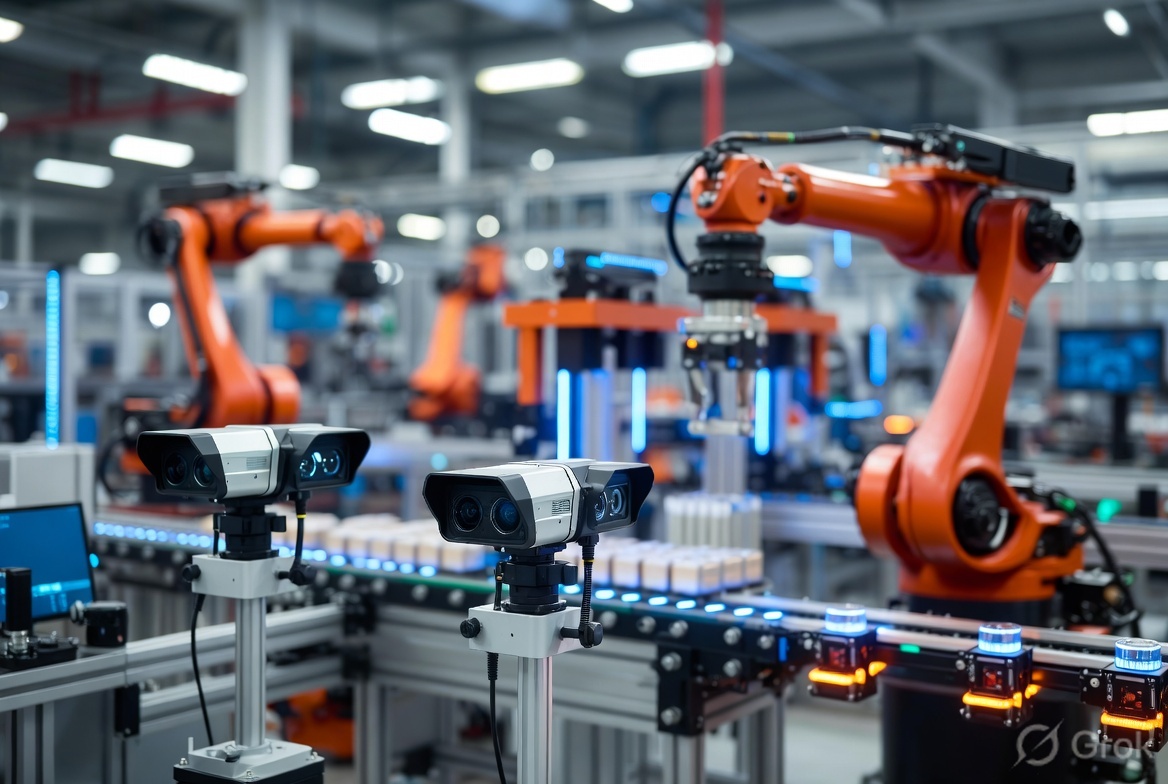
The global Industrial Vision Market is a cornerstone of Industry 4.0, enabling manufacturers, logistics operators, and process industries to deploy AI-powered machine vision systems that automate quality inspection, guide robotic assembly, monitor production lines, and ensure workplace safety. Valued at $14.9 billion in 2023, the market is projected to reach $26.8 billion by 2032 at a 7.8% CAGR. Deep learning-based vision models, 3D imaging, hyperspectral cameras, and edge AI processors are expanding machine vision capabilities far beyond traditional rule-based optical inspection systems.
What Is Driving the Industrial Vision Market?
- AI Deep Learning Defect Detection: Convolutional neural networks trained on production imagery achieve 99.5%+ defect detection accuracy across semiconductor, automotive, electronics, and food manufacturing — outperforming human visual inspection at a fraction of the cost.
- Collaborative Robot (Cobot) Vision Guidance: Industrial vision systems provide real-time spatial awareness and object recognition for collaborative robots, enabling flexible, reprogrammable assembly, pick-and-place, and bin-picking workflows.
- 3D Vision & Structured Light Scanning: 3D machine vision systems provide dimensional measurement, surface profiling, and volumetric analysis capabilities required for precision aerospace, medical device, and automotive body panel inspection.
- Edge AI Vision Processing: Deploying deep learning inference directly on smart cameras and embedded vision processors eliminates cloud latency, enabling real-time inspection decisions at line speeds exceeding 1,000 parts per minute.

Access the full Industrial Vision Market report for complete forecasts, segmentation analysis, and competitive landscape data.
Segment & Application Breakdown
| Application | Primary Industry | Use Case | Key Driver |
| Quality Inspection Systems | Electronics, Automotive, Pharma | Surface defect, dimensional, colour inspection | Zero-defect manufacturing, scrap reduction |
| Robotic Guidance Vision | Automotive, Logistics, Assembly | Pick-and-place, seam tracking, bin picking | Flexible automation, labour cost reduction |
| 3D Vision & Metrology | Aerospace, Medical Devices, Semi | Precision measurement, surface profiling | Tolerance compliance, regulatory approval |
| Safety & Surveillance Vision | Industrial Plants, Warehouses | PPE compliance, zone monitoring, intrusion | Worker safety, HSE compliance, liability reduction |
KEY INSIGHT
Manufacturers deploying AI-powered industrial vision inspection systems report a 94% reduction in defect escape rates, a 61% decrease in manual inspection labour costs, and a payback period of under 12 months across electronics and automotive production line deployments.
Regional Market Breakdown
| Region | Maturity | Key Drivers | Outlook |
| North America | Mature | Semiconductor inspection, aerospace metrology, warehouse robotics vision | Highest technology value; AI vision platform leadership |
| Europe | Strong | Automotive quality vision, pharma inspection, Industry 4.0 integration | German manufacturing excellence + cobot adoption |
| Asia-Pacific | Dominant Volume | China electronics/PCB inspection, Japan robotics, South Korea semiconductor | World’s largest manufacturing base; fastest AI vision adoption |
| Middle East | Expanding | Oil & gas pipeline inspection, smart port vision, NEOM smart factory | Industrial modernisation and Vision 2030 smart manufacturing |
Competitive Landscape
Leading players operating in the Industrial Vision Market include: Cognex, Keyence, Basler, ISRA VISION, Omron, Teledyne DALSA, National Instruments, Zebra Technologies.
Market Outlook Through 2032
Through 2032, the Industrial Vision Market will be defined by the fusion of AI deep learning, 3D imaging, and edge processing into fully autonomous inspection and guidance systems. Vendors delivering adaptable, no-code vision AI platforms with pre-trained industrial models will capture dominant market share across electronics, automotive, and pharmaceutical manufacturing.
Get the full data — free sample available:
→ Download Free Sample PDF: Industrial Vision Market Sample Report
→ Purchase Full Report: Industrial Vision Market Full Report (2025–2032)
Market data sourced from Market Research Future (MRFR). Published March 2026. For custom research enquiries, contact MRFR.