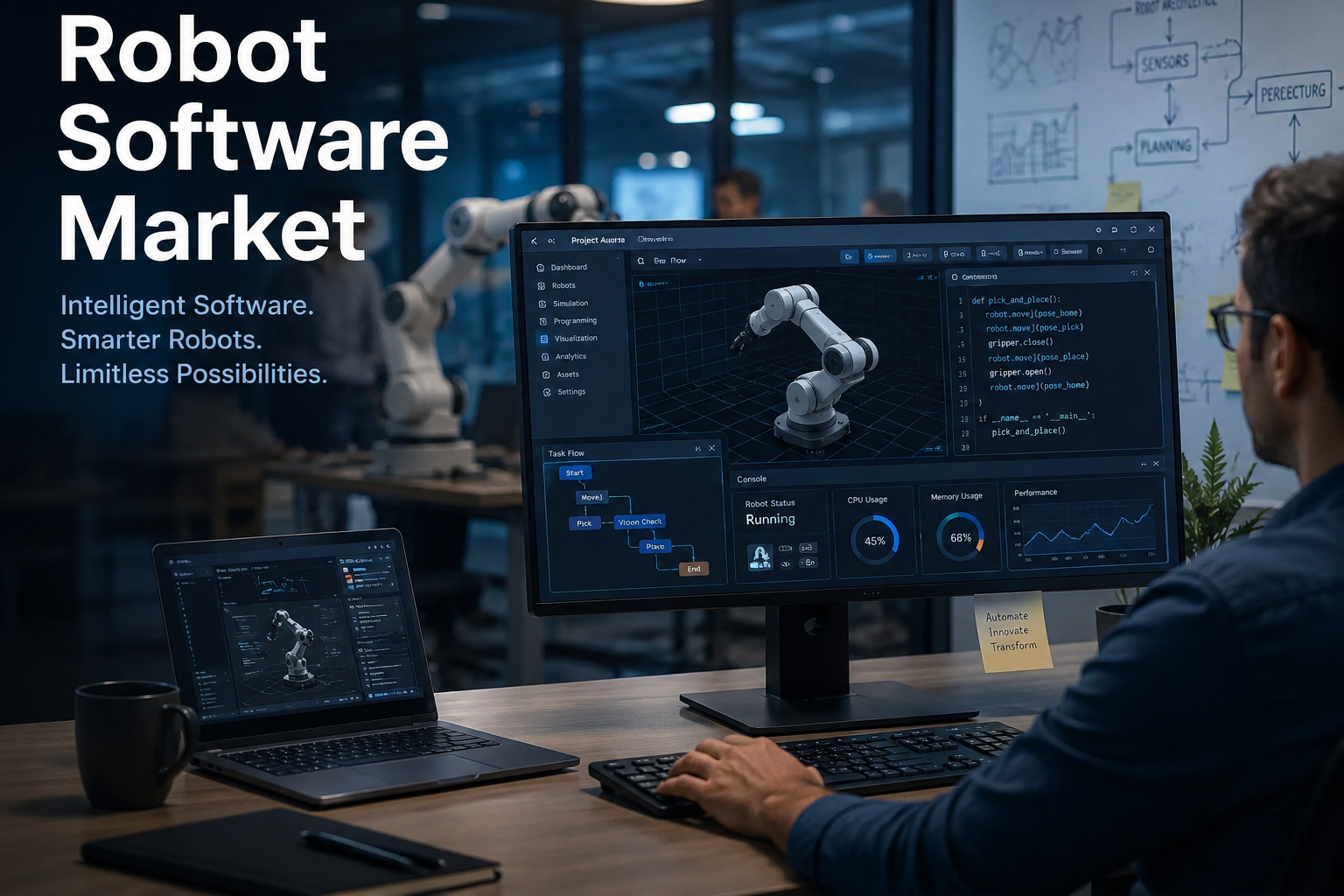
Robot Software | Robotics Software | AI Robotics | Regional Breakdown | April 2026 | Source: MRFR
92.46B∗∗∣∗∗24.378.395B
Market Value by 2035 | CAGR (2025-2035) | Market Value in 2024
Robot Software Market
Key Takeaways
-
Robot Software Market is projected to reach USD 92.46 billion by 2035 at a 24.37% CAGR .
-
Healthcare leads the vertical segment; Retail & e-commerce is the fastest-growing .
-
Industrial robots hold the largest share; Service robots are the fastest-growing .
 ADVERTISEMENT
 -
On-premise deployment leads; Cloud deployment is the fastest-growing .
-
ABB, KUKA, Siemens, Fanuc, Yaskawa, and Boston Dynamics lead the competitive landscape .

The Robot Software Market is projected to grow from USD 8.395 billion in 2024 to USD 92.46 billion by 2035 at a 24.37% CAGR , driven by rising demand for automation across industries, integration of AI and machine learning, and the adoption of Robotics Software and AI Robotics platforms that enable intelligent task execution, real-time decision-making, and scalable deployment across BFSI, retail, healthcare, logistics, manufacturing, and IT & telecommunication sectors .
Market Size and Forecast (2024-2035)
| Metric | 2024 Value | 2035 Projected Value / CAGR |
|---|---|---|
| Robot Software Market | USD 8.395B | USD 92.46B | 24.37% CAGR |
*Source: Market Research Future *
Segment & Technology Breakdown
| Vertical | Segment | Primary Buyer | Key Driver |
|---|---|---|---|
| Healthcare | Surgery, Care | Hospitals | Patient outcomes |
| Manufacturing | Production | Industrial Firms | Efficiency |
| Logistics | Fulfillment | Distribution | Speed |
| Retail & e-commerce | Automation | Retailers | Customer experience |
| BFSI | Security, Service | Financial Institutions | Automation |
| IT & Telecommunication | Operations | Tech Firms | Efficiency |
| Robot Type | Segment | Primary Buyer | Key Driver |
|---|---|---|---|
| Industrial Robots | Manufacturing | Production Managers | Precision, productivity |
| Service Robots | Commercial, Domestic | Service Providers | Customer interaction |
| Deployment | Segment | Primary Buyer | Key Driver |
|---|---|---|---|
| On-premise | Secure | Large Enterprises | Data control |
| Cloud-based | Scalable | SMEs | Flexibility, lower costs |
| Organization Size | Segment | Primary Buyer | Key Driver |
|---|---|---|---|
| SMEs | Agile | Small Businesses | Cost-effective solutions |
| Large Enterprises | Complex | Global Corporations | Scale, integration |
*Source: Market Research Future *
What Is Driving the Robot Software Market Demand?
Rising Demand for Automation: The automation market is projected to grow at over 10% CAGR. Industries such as manufacturing, logistics, and healthcare are increasingly adopting robotic solutions to enhance efficiency and reduce operational costs .
Advancements in Robotics Technology: Innovations in sensors, AI, and machine learning enable robots to perform complex tasks with greater precision and reliability. Collaborative robots (cobots) allow safer human-robot interactions in manufacturing environments .
Expansion of E-commerce and Logistics: The logistics sector is projected to exceed 200 billion USD by 2025, necessitating advanced robotic software to manage inventory, fulfill orders, and streamline distribution processes .
Growing Focus on Sustainability: Organizations are adopting robotic solutions to minimize waste and enhance energy efficiency. Robots equipped with advanced software can optimize supply chain processes, reducing carbon footprints and resource consumption .
KEY INSIGHT
|> Healthcare leads the vertical segment, driven by robotic automation for enhancing patient care and operational efficiency. Retail & e-commerce is the fastest-growing segment, driven by demand for automated inventory management and customer service solutions. North America holds the largest market share at 40%, driven by significant investments in automation technologies .
Get the full data — free sample available:
→ Download Free Sample PDF: Robot Software Market
Includes market sizing, segmentation methodology, and regional forecast tables.
Regional Market Breakdown
| Region | Maturity | Key Drivers | Outlook |
|---|---|---|---|
| North America | Largest (40%) | AI integration, supportive policies | Strong growth |
| Europe | Second Largest (30%) | Manufacturing base, Industry 4.0 | Germany, France lead |
| Asia-Pacific | Rapid Growth (25%) | Industrial automation, robotics adoption | China, Japan lead |
| Middle East & Africa | Emerging (5%) | Automation investments | UAE, South Africa lead |
*Source: Market Research Future *
Competitive Landscape
| Category | Key Players |
|---|---|
| Industrial Robotics | ABB (CH), KUKA (DE), Fanuc (JP), Yaskawa (JP) |
| Automation Leaders | Siemens (DE), Rockwell Automation (US) |
| Advanced Robotics | Boston Dynamics (US), Intuitive Surgical (US) |
| Vision & Control | Omron (JP), Cognex (US) |
*Source: Market Research Future *
Outlook Through 2035
The convergence of AI integration, cloud-based platforms, and robotic process automation will define the robot software market through 2035. Key trends shaping the market include:
Integration of AI and Machine Learning: AI enables robots to learn from environments and adapt to new tasks, enhancing functionality and efficiency across applications from manufacturing to healthcare.
Focus on Safety and Compliance: Companies are prioritizing software that adheres to regulatory standards, ensuring safe operation in various environments as robot deployment becomes more widespread.
Expansion into New Industries: Robot software is expanding beyond traditional manufacturing into agriculture, healthcare, and retail, driving demand for specialized software tailored to diverse applications.
Cloud-Based Robot Management: AI-driven analytics and cloud-based orchestration platforms enabling enterprises to deploy and manage large-scale robotic fleets with centralized coordination and monitoring.
Robot Fleet Management: AI-powered scheduling and predictive maintenance capabilities supporting multi-robot ecosystems in warehouse automation and logistics optimization.
Vendors investing in AI integration, cloud-native platforms, safety-compliant software, and vertical-specific solutions will capture the highest-margin contracts as robot software evolves from basic control systems to intelligent orchestration platforms for autonomous operations.
Access complete forecasts, segment analysis & competitive intelligence:
→ Purchase the Full Robot Software Market Report (2025-2035)
*10-year forecasts | Segment & application analysis | Regional data | Competitive landscape*
Keywords: Robot Software | Robotics Software | AI Robotics | Industrial Robot Software | Service Robot Software | Cloud Robotics | Robot Fleet Management
© 2025 Market Research Future (MRFR) · All Rights Reserved · marketresearchfuture.com
All market projections are forward-looking estimates sourced from MRFR’s proprietary research reports and subject to revision.