Mordor Intelligence has published a new report on the virtual cards market, offering a comprehensive analysis of trends, growth drivers, and future projections
Virtual Cards Market Overview
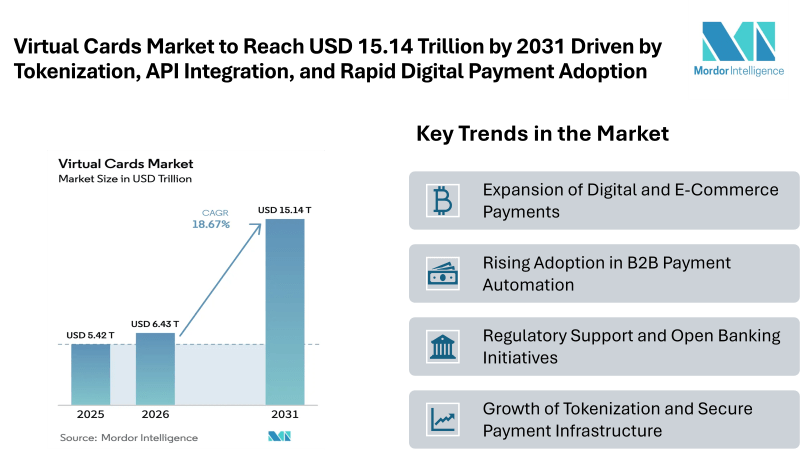
According to Mordor Intelligence, the virtual cards market size is expected to witness strong growth, expanding from USD 5.42 trillion in 2025 to USD 6.43 trillion in 2026, and reaching approximately USD 15.14 trillion by 2031. This reflects a robust compound annual growth rate of 18.67%. This rapid expansion is being fueled by the increasing convergence of payment systems and software platforms, enabling virtual cards to offer highly programmable and API-driven payment experiences. Innovations in tokenization are significantly enhancing transaction security, improving authorization rates, and reducing fraud across digital and in-app commerce environments. At the same time, the rise of open banking frameworks is streamlining funding and settlement processes by enabling standardized data sharing through APIs. Enterprises, particularly treasury departments, are accelerating adoption as virtual cards provide automated reconciliation, enhanced spend control, and improved working capital management.
Virtual Cards Market Growth Drivers
Expansion of Digital and E-Commerce Payments
The rapid evolution of digital commerce is significantly accelerating the adoption of virtual cards across remote and in-app payment environments. Businesses and consumers are increasingly relying on tokenized credentials integrated into mobile wallets and merchant applications, enabling seamless and secure transactions. This shift toward digital-first payment methods reflects a broader transformation in consumer behavior, where convenience and security are paramount. The growing preference for mobile-based transactions and card-not-present payments is reinforcing the demand for virtual card solutions. Wallet-centric ecosystems are also enhancing cross-border payment accessibility by enabling users to transact globally through virtual card issuance.

Rising Adoption in B2B Payment Automation
The increasing shift toward automation in business payments is driving significant growth in virtual card usage within accounts payable processes. Organizations are transitioning away from traditional payment methods and adopting virtual card workflows that integrate directly with enterprise resource planning systems and payment automation platforms. This integration reduces processing time, minimizes manual intervention, and improves overall operational efficiency. Finance leaders are recognizing the strategic value of virtual cards in strengthening supplier relationships and enhancing payment transparency. Automated invoicing and payment processing capabilities are becoming essential for modern enterprises, supporting faster settlements and improved cash flow management.
Regulatory Support and Open Banking Initiatives
Government and regulatory bodies are playing a pivotal role in shaping the growth of the Virtual Cards Market by promoting cash-lite economies and advancing open banking frameworks. These initiatives aim to reduce reliance on cash while improving access to digital financial infrastructure. By enabling standardized data sharing through APIs, open banking is facilitating seamless connectivity between financial institutions and third-party providers. Such regulatory developments are simplifying the issuance, funding, and management of virtual cards, making them more accessible to businesses and consumers alike. Additionally, the rise of real-time payment systems and enhanced security requirements is encouraging the adoption of tokenized payment credentials.
Growth of Tokenization and Secure Payment Infrastructure
Advancements in tokenization and digital security technologies are further accelerating the adoption of virtual cards across various use cases. Tokenization replaces sensitive card information with secure digital identifiers, reducing the risk of fraud and unauthorized access. This approach is particularly valuable in online and mobile payment environments, where security concerns are more pronounced. As financial institutions and payment networks continue to enhance tokenization capabilities, virtual cards are benefiting from improved authorization rates and stronger fraud prevention mechanisms. These developments are supporting wider acceptance of virtual cards among merchants and service providers.
Check out more details and stay updated with the latest industry trends, including the Japanese version for localized insights: https://www.mordorintelligence.com/ja/industry-reports/virtual-cards-market?utm_source=emailwire
Virtual Cards Market Segmentation Analysis
By Use
- Single-Use
- Multi-Use
By Payment Type
- Remote Payments
- POS Payments
By End User
- Consumer
- Business
By Card Type
- Virtual Debit Card
- Virtual Credit Card
- Virtual Prepaid Card
By Region
- North America
- United States
- Canada
- Mexico
- South America
- Brazil
- Argentina
- Chile
- Peru
- Rest of South America
- Europe
- United Kingdom
- Germany
- France
- Spain
- Italy
- Benelux (Belgium, Netherlands, and Luxembourg)
- Nordics (Sweden, Norway, Denmark, Finland, and Iceland)
- Rest of Europe
- Asia-Pacific
- China
- India
- Japan
- South Korea
- Australia
- South-East Asia (Singapore, Indonesia, Malaysia, Thailand, Vietnam, and Philippines)
- Rest of Asia-Pacific
- Middle East and Africa
- United Arab Emirates
- Saudi Arabia
- South Africa
- Nigeria
- Rest of Middle East and Africa
Explore Our Full Library of Financial Services and Investment Intelligence Research Reports: https://www.mordorintelligence.com/market-analysis/financial-services-and-investment-intelligence?utm_source=emailwire
- American Express Company
- Mastercard Incorporated
- Visa Inc.
- JPMorgan Chase & Co.
- Marqeta Inc.
- Stripe Inc.
- PayPal Holdings Inc.
- WEX Inc.
- Corpay (Fleetcor)
- AirPlus International
- Revolut Ltd.
- Brex Inc.
- Adyen NV
- Citi (Citigroup Inc.)
- BMO Financial Group
- MineralTree Inc.
- Billtrust Inc.
- Fraedom Holdings Ltd.
- Coupa
- Tribal Credit
Conclusion
The Virtual Cards Market is entering a phase of sustained and transformative growth, driven by the rapid digitization of payments and the increasing need for secure, flexible, and scalable financial solutions. As businesses and consumers continue to shift toward digital-first transactions, virtual cards are emerging as a critical tool for enabling seamless and controlled payment experiences across both online and enterprise environments. The convergence of financial services with technology platforms is reshaping how payments are initiated, processed, and managed. Virtual cards, with their programmable features and integration capabilities, are at the center of this evolution. They not only enhance transaction security through tokenization but also enable real-time visibility, automated reconciliation, and improved financial governance for organizations.
For more insights on the virtual cards market, please visit the Mordor Intelligence page: https://www.mordorintelligence.com/industry-reports/virtual-cards-market?utm_source=emailwire
Industry Related Reports:
- UK Virtual Cards Market Size:https://www.mordorintelligence.com/industry-reports/uk-virtual-cards-market?utm_source=emailwire
- Europe Credit Cards Market Share:https://www.mordorintelligence.com/industry-reports/europe-credit-cards-market?utm_source=emailwire
- Global Credit Cards Market:https://www.mordorintelligence.com/industry-reports/global-credit-cards-market?utm_source=emailwire
- Israel Credit Cards Market Analysis:https://www.mordorintelligence.com/industry-reports/israel-credit-cards-market?utm_source=emailwire
About Mordor Intelligence:
Mordor Intelligence is a trusted partner for businesses seeking comprehensive and actionable market intelligence. Our global reach, expert team, and tailored solutions empower organizations and individuals to make informed decisions, navigate complex markets, and achieve their strategic goals.
With a team of over 550 domain experts and on-ground specialists spanning 150+ countries, Mordor Intelligence possesses a unique understanding of the global business landscape. This expertise translates into comprehensive syndicated and custom research reports covering a wide spectrum of industries, including aerospace & defense, agriculture, animal nutrition and wellness, automation, automotive, chemicals & materials, consumer goods & services, electronics, energy & power, financial services, food & beverages, healthcare, hospitality & tourism, information & communications technology, investment opportunities, and logistics.
For any inquiries or to access the full report, please contact:
media@mordorintelligence.com
https://www.mordorintelligence.com/
Mordor Intelligence, 11th Floor, Rajapushpa Summit, Nanakramguda Rd, Financial District, Gachibowli, Hyderabad, Telangana – 500032, India.