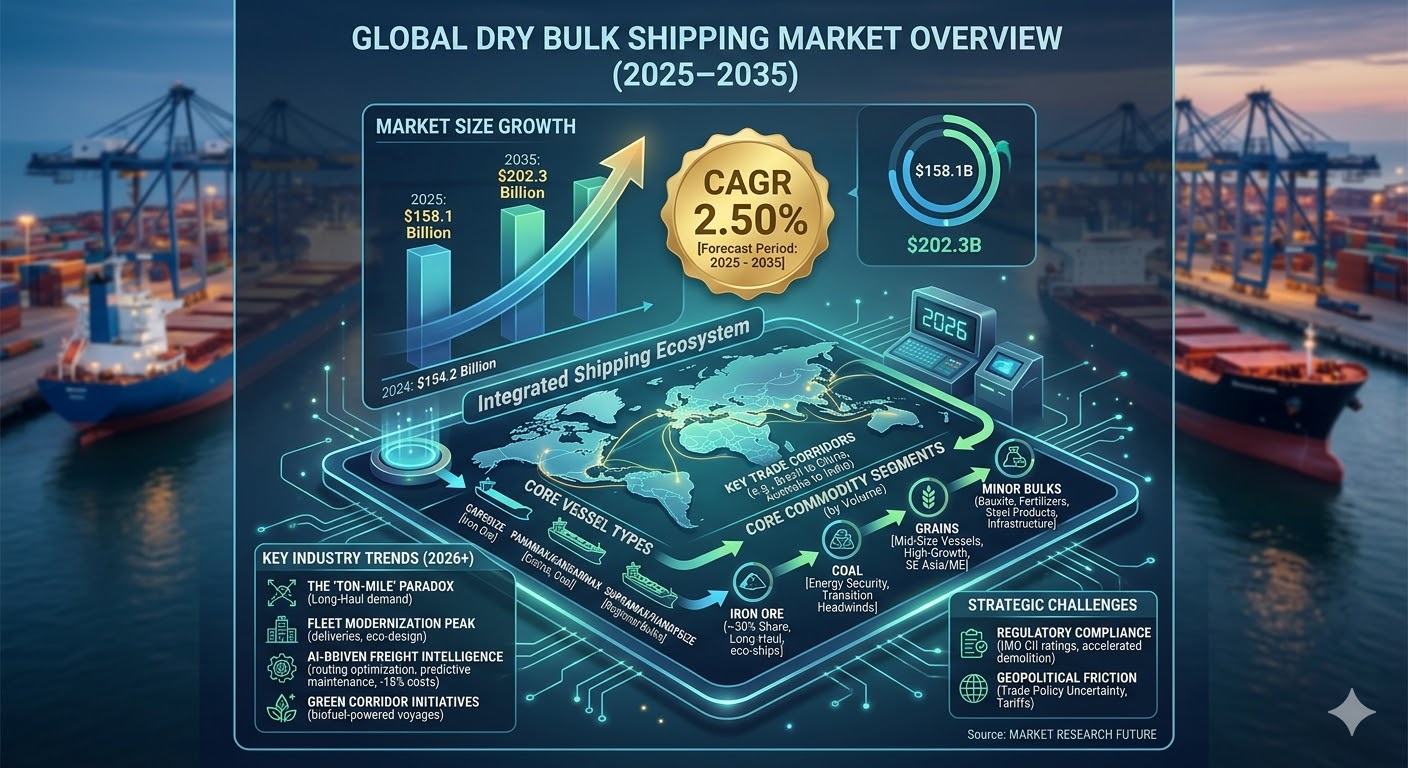
Every ton of iron ore that feeds a steel mill, every shipload of coal that powers an energy grid, and every cargo of grain that sustains a nation’s food supply travels, at some point, on a dry bulk vessel. These enormous ships are the invisible workhorses of the global economy — unsung, unglamorous, and utterly indispensable. And the industry behind them is growing steadily, underpinned by the relentless demand for raw materials and a sector-wide push toward modernization.
According to a comprehensive analysis by Market Research Future, the global dry bulk shipping market was valued at USD 154.2 billion in 2024 and is projected to reach USD 202.3 billion by 2035, expanding at a compound annual growth rate (CAGR) of 2.50% over the forecast period. While the pace of growth reflects the mature nature of a sector deeply tied to global commodity cycles, the absolute scale of expansion underscores how critical this industry remains to international trade.
What Moves the Market
At its core, dry bulk shipping is driven by the movement of unpackaged goods — primarily iron ore, coal, grains, bauxite/alumina, and phosphate rock. These commodities form the backbone of industrial production, energy supply, and agricultural distribution worldwide. As emerging economies industrialize and urbanize, their appetite for these raw materials grows, generating consistent demand for bulk shipping capacity.
The rising demand for raw materials is one of the most powerful drivers shaping the dry bulk shipping market. Iron ore shipments alone are projected to grow approximately 3% annually over the next five years, driven by steel production needs in Asia and beyond. The green energy transition is adding new dimensions to demand as well — the manufacture of wind turbines, solar panels, and electric vehicle batteries requires copper, lithium, and other minerals that must also be transported at scale.
Infrastructure investment is a second major catalyst. Port modernization programs across Asia, the Middle East, and Africa are reducing turnaround times, improving vessel utilization, and expanding the overall throughput capacity of global shipping networks. Investments in port infrastructure have risen significantly in recent years, reflecting a coordinated effort to bring shipping infrastructure in line with the growth of global trade volumes.

Vessel Segments: Giants and Versatile Operators
The dry bulk fleet is segmented by vessel size, each serving distinct trade routes and cargo profiles. Capesize vessels — the largest in the category — dominate the market by volume. Their massive carrying capacity makes them cost-efficient for long-haul iron ore and coal routes connecting South America and Australia to Asian steel hubs. Their scale, however, limits them to deep-water ports.
The Supramax segment is the fastest-growing category, and for good reason. These mid-sized vessels offer the flexibility to handle a diverse range of cargo types — from grains to minor bulks — and can access shallower ports that are off-limits to Capesize ships. As trade patterns diversify and new markets emerge in Southeast Asia, Africa, and South Asia, the operational versatility of Supramax vessels is becoming increasingly valuable.
Panamax and Handysize vessels round out the fleet, each serving specific trade corridors and cargo requirements that contribute to a well-diversified and resilient global shipping ecosystem.
The escalating conflict involving Israel, Iran, and the United States is creating significant day-to-day volatility in the global dry bulk shipping industry. One of the most immediate effects is the surge in global oil prices due to disruptions in Middle Eastern supply routes such as the Strait of Hormuz, a corridor that normally carries about one-fifth of global oil shipments. Recent tensions have pushed crude prices sharply upward and disrupted shipping routes, raising fuel, logistics, and manufacturing costs worldwide.
Download Report Sample Copy with TOC: https://www.marketresearchfuture.com/sample_request/8308
Technology and Sustainability at the Helm
Perhaps the most transformative force reshaping dry bulk shipping today is the convergence of digital technology and environmental regulation. The International Maritime Organization’s sulfur cap regulations have already prompted widespread adoption of low-sulfur fuels and scrubber technologies, fundamentally altering operating cost structures across the industry.
Innovation is accelerating on multiple fronts. In January 2026, Berge Bulk completed the installation of rotor sail technology on its Newcastlemax vessel Berge Meru, harnessing wind energy to reduce fuel consumption and carbon emissions — a milestone that signals the growing viability of wind-assisted propulsion for large commercial vessels.
On the digital side, artificial intelligence and real-time data analytics are being deployed to optimize routing, predict maintenance needs, and reduce fuel consumption. Reports suggest that integrating these technologies could reduce operational costs by up to 10% over the coming years. Meanwhile, consolidation in the sector — exemplified by the landmark merger of Star Bulk and Eagle Bulk in 2023, creating the largest US-listed dry bulk company with 169 vessels — reflects a broader trend toward scale-driven efficiency.
The Road Ahead
Asia-Pacific, holding approximately 41% of the global market share, will continue to be the engine of dry bulk shipping demand, led by China’s iron ore requirements and India’s growing energy and infrastructure needs. Europe’s regulatory framework and North America’s commodity export base will sustain steady demand from established markets.
Purchase Now: https://www.marketresearchfuture.com/checkout?currency=one_user-USD&report_id=8308
For more insights on Market, visit the Market Research Future page and explore detailed market analysis, forecasts, and company strategies.